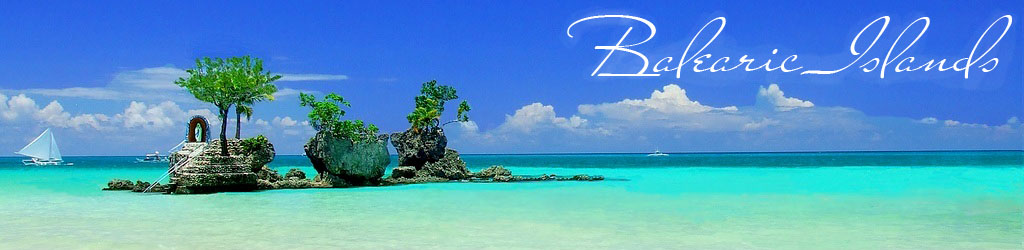
Balearic Islands

Ibiza island is situated in the balearic archipel. This is the third island in term of surface after Mallorca and Minorca. Ibiza surface is 541 22 km² with 210 km of coastline. The population of the island is 75 000 inhabitants.
Well known for it night activities, Ibiza is also a wonderfull island, with emeralds beaches, and an always blue sky (more than 300 days of sunshine per year).
Come here to discover more than 50 wonderfull beaches and spend unforgettable holidays.
While it is one-sixth the size of nearby Majorca, Ibiza is over five timesthe size of Mykonos (Greece), or ten times the size of Manhattan Island. Ibiza has become famous for the association with nightlife and the electronic music that originated on the island. It is well known for its summer club scene which attracts very large numbers of tourists, though the island's government and the Spanish Tourist Office have controversially been working to promote more family-oriented tourism.
Ibiza is the home of the noted port in Ibiza Town, a popular stop for many tourists and now a UNESCO World Heritage Site.
Ibiza and the nearby island of Formentera to its south are called the Pine Islands, or "Pityuses".
Ancient Greek aryballoi found in the necropolis of Puig des Molins. Museo de Puig des Molins, Ibiza.
In 654 BC, Phoenician settlers founded a port in the Balearic Islands, as Ibossim (from the Phoenician "iboshim" dedicated to the Egyptian god of music and dance Bes).[2] It was later known to Romans as "Ebusus". The Greeks called the two islands of Ibiza and Formentera the Pityûssai (Greek: ??t???ssa?, "pine-covered islands").[3] With the decline of Phoenicia after the Assyrian invasions, Ibiza came under the control of Carthage, also a former Phoenician colony. The island produced dye, salt, fish sauce (garum), and wool.
A shrine with offerings to the goddess Tanit was established in the cave at Es Cuieram, and the rest of the Balearic Islands entered Eivissa's commercial orbit after 400 BC. Ibiza was a major trading post along the Mediterranean routes. Ibiza began establishing its own trading stations along the nearby Balearic island of Majorca, such as Na Guardis, where numerous Balearic mercenaries hired on, no doubt as slingers,[4] to fight for Carthage.
During the Second Punic War, the island was assaulted by the two Scipio brothers in 209 BC but remained loyal to Carthage. With the Carthaginian military failing on the Iberian mainland, Ibiza was last used by the fleeing Carthaginian General Mago to gather supplies and men before sailing to Minorca and then to Liguria. Ibiza negotiated a favorable treaty with the Romans, which spared Ibiza from further destruction and allowed it to continue its Carthaginian-Punic institutions well into the Empire days, when it became an official Roman municipality. For this reason, Ibiza today contains excellent examples of late Carthaginian-Punic civilization. During the Roman Empire, the island became a quiet imperial outpost, removed from the important trading routes of the time.[citation needed]
After the fall of the Western Roman Empire and a brief period of first Vandal and then Byzantine rule, the island was conquered by the Moors in 990, the few remaining locals converted to Islam and Berber settlers came in. Under Islamic rule, Ibiza came in close contact with the city of Dénia—the closest port in the nearby Iberian peninsula, located in the Valencian Community—and the two areas were administered jointly by the Taifa of Dénia.
Ibiza together with the islands of Formentera and Minorca were invaded by the Norwegian king Sigurd I of Norway in the spring of 1110 on his crusade to Jerusalem. The king had previously conquered the cities of Sintra, Lisbon, and Alcácer do Sal and given them over to Christian rulers, in an effort to weaken the Muslim grip on the Iberian peninsula. King Sigurd continued to Sicily where he visited King Roger II of Sicily.
The island was conquered by Aragonese King James I in 1235. The local Muslim population got deported as was the case with neighboring Majorca and elsewhere, and Christians arrived from Girona. The island maintained its own self-government in several forms until 1715, when King Philip V of Spain abolished the local government's autonomy. The arrival of democracy in the late 1970s led to the Statute of Autonomy of the Balearic Islands. Today, the island is part of the Balearic Autonomous Community, along with Majorca, Minorca, and Formentera.